Motorcycle accident claim bias in Florida affects how cases are evaluated long before a jury is seated.
From the moment a crash report is filed, assumptions about motorcyclists may shape how police document the scene, how adjusters calculate offers, and how juries weigh the evidence. For riders in Fort Lauderdale and across South Florida, understanding where that bias shows up and how to counter it with evidence is critical to protecting a claim’s value. Speaking with a motorcycle accident attorney early may help identify where bias is already affecting your case. A Fort Lauderdale personal injury lawyer familiar with rider bias can make a significant difference in how your claim is built from day one.
Key Takeaways for Motorcycle Accident Claim Bias in Florida
- In roughly two-thirds of multi-vehicle motorcycle crashes, the other driver is at fault, yet motorcyclists are frequently treated as the presumed cause
- Bias against riders may appear at every stage of a claim, from police reports to adjuster evaluations to jury deliberations
- Florida’s modified comparative fault system makes bias especially dangerous, since fault above 50% eliminates recovery entirely
- Florida’s partial helmet law is legal for qualifying riders, but insurers routinely use helmet choice as a tool to shift blame
- Strong physical evidence, including crash reconstruction, event data recorders, and surveillance footage, is the most effective counter to stereotype-driven arguments
Where Motorcycle Accident Claim Bias Starts
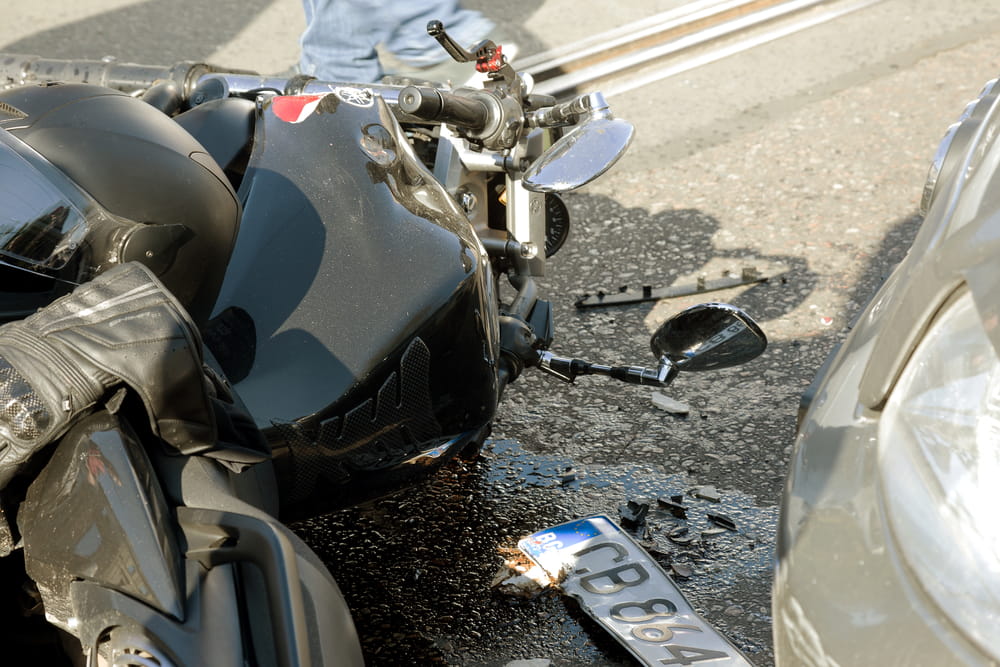
Bias against motorcyclists does not begin in a courtroom. It begins at the crash scene and follows the claim through every stage of the process.
The Police Report
Law enforcement officers responding to crash scenes may harbor unconscious biases that affect their reports. An officer unfamiliar with motorcycle dynamics might misinterpret tire marks, misjudge approach speed, or frame the narrative around the motorcycle rather than the vehicle that caused the collision.
Because police reports often serve as the foundation for insurance evaluations and litigation, errors or assumptions at this stage may carry forward for months.
The Adjuster’s Desk
Insurance companies count on the inherent bias of the general public against motorcycle riders to drive the value of every motorcycle accident injury case. When two cars crash, fault is usually assigned based on the facts. However, if a motorcycle is involved, the motorcyclist faces a higher burden of proof because of perception, prejudice, and bias.
Adjusters may start from the assumption that the rider was aggressive, speeding, or weaving, then look for evidence to support that conclusion rather than evaluating the facts neutrally. That framing affects the initial offer and every negotiation that follows.
The Jury Box
In a jury trial, a motorcyclist might receive a smaller damage award than a car accident victim for similar injuries because the jury members have an implicit bias against the rider.
Motorcycle stereotype jury bias does not require jurors to be openly hostile. Subtle assumptions about risk-taking, lifestyle choices, or recklessness may influence how they interpret the same evidence that would favor a car driver in an identical scenario.
The Stereotypes Insurers Rely On After a Florida Motorcycle Accident
Insurance defense strategies in motorcycle cases often lean on a set of recurring assumptions, none of which prove fault but all of which may influence perception.
“Motorcyclists Are Reckless by Nature”
Without evidence, adjusters frequently assume motorcyclists were speeding or driving aggressively. They may point to the motorcycle’s performance capabilities or the severity of injuries as implied proof of excessive speed, ignoring that riders suffer more severe injuries even at legal speeds due to the lack of an enclosed vehicle structure.
The reality contradicts this assumption. Per vehicle miles traveled in 2023, motorcyclists were about 28 times more likely than passenger car occupants to die in a motor vehicle crash, but that statistic reflects vulnerability, not recklessness. 74% of motorcycle operators involved in fatal crashes were not alcohol-impaired, a fact that undermines the stereotype of the irresponsible rider.
“They Chose the Risk”
A common defense argument frames motorcycle riding itself as an acceptance of danger. The implication is that by choosing a motorcycle over a car, the rider assumed the risk of injury and bears some inherent responsibility for the outcome.
Florida law does not support this reasoning. Under Fla. Stat. § 316.209, motorcycles are entitled to full use of a lane, and operating a motorcycle is legal and regulated in Florida.
Riding a motorcycle is legal, regulated, and entitled to the same right-of-way protections as any other vehicle on the road.
“The Rider Wasn’t Visible Enough”
Visibility defense arguments place the burden on the rider to make themselves seen rather than on the driver to look. Adjusters may argue that the rider wore dark clothing, lacked reflective gear, or was positioned in a blind spot, shifting blame from the driver who failed to check before turning or changing lanes.
In most multi-vehicle motorcycle crashes, the issue is not that the rider was invisible. According to NHTSA’s 2022 motorcycle crash data, 77% of motorcycles in fatal two-vehicle crashes were struck in the front, indicating the other vehicle crossed into the motorcycle’s path.
Federal data consistently shows that other drivers are at fault in roughly 60% of multi-vehicle motorcycle crashes, most often because the driver failed to yield or misjudged the motorcycle’s speed. That is a detection failure by the driver, not a visibility failure by the rider.
How Florida’s Helmet Law Becomes a Blame Tool

Florida’s partial helmet law creates a unique pressure point in motorcycle accident claims. Under Fla. Stat. § 316.211, riders over 21 who carry at least $10,000 in medical benefits coverage may legally ride without a helmet. That is a lawful choice under Florida statute. But making a legal choice does not stop insurers from using it against you.
The Legal Gray Area
Helmet choice does not cause a crash. Traditional mitigation-of-damages doctrine applies to conduct after an injury occurs, not before. Even so, insurers and defense lawyers may argue that a rider’s decision not to wear a helmet contributed to head-related injuries.
In practice, Florida courts have not drawn that line so cleanly. Defense attorneys routinely argue that riding without a helmet increased the severity of injuries, framing it as comparative fault rather than a causation issue. If that argument sticks, it adds percentage points to the rider’s fault assignment.
When the Argument Has Teeth, and When It Doesn’t
The helmet defense carries the most weight when the rider sustained head or facial injuries. In those cases, an insurer may argue that a helmet would have reduced the severity of the damage, and a jury may find that persuasive.
For injuries unrelated to the head, the argument falls apart. A broken femur, fractured pelvis, or internal organ damage has no logical connection to whether the rider wore a helmet. That disconnect weakens the defense significantly.
Why It Matters More Under Florida’s New Fault Rules
Before 2023, even a successful helmet argument only reduced compensation. Under Florida’s modified comparative fault system established by HB 837, the stakes are higher.
If helmet non-use, combined with other bias-driven fault arguments about speed, visibility, or lane positioning, pushes the rider’s total fault above 50%, the claim is worth zero under Fla. Stat. § 768.81.
That cumulative risk is what makes the helmet law impact on injury claims so significant in post-reform Florida.
Proving Fault in a Motorcycle Crash in Florida
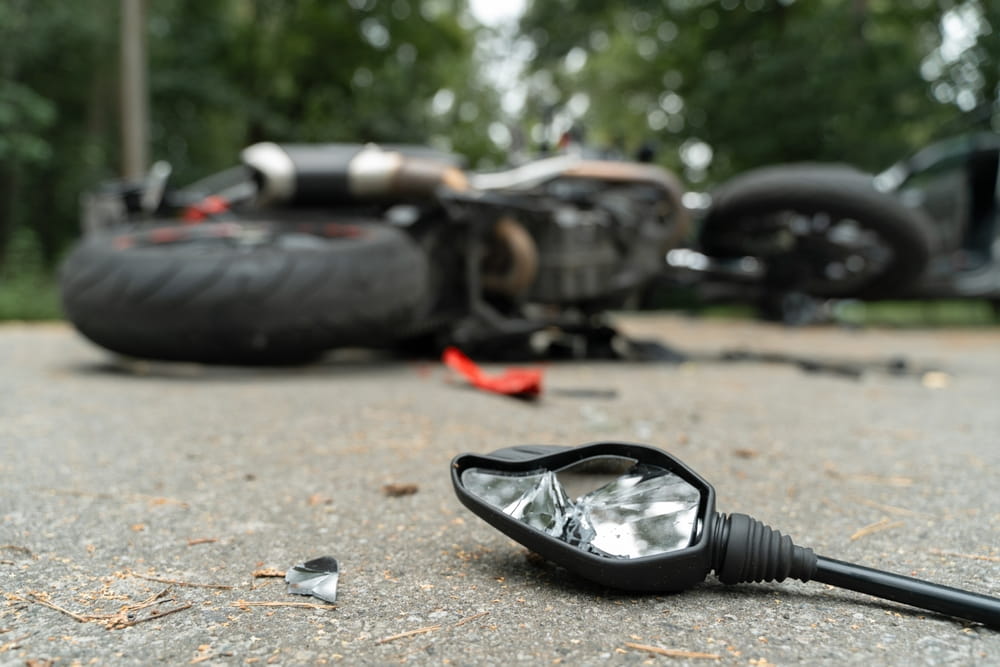
Proving fault in a motorcycle crash in Florida requires evidence that speaks louder than assumptions. The strongest motorcycle accident claims are built on physical proof that establishes what happened independent of anyone’s opinion about motorcyclists.
Crash Scene Evidence
Physical evidence collected at or near the scene forms the foundation of fault analysis:
- Gouge marks, debris patterns, and final rest positions help reconstruct the sequence of the collision
- Traffic camera and nearby surveillance footage may capture the moments before impact, showing which party violated right-of-way
- Skid marks and tire evidence indicate braking behavior and approach angles for both vehicles
- Road condition documentation, including signage, lane markings, and sight lines, may support or undermine visibility defense arguments
This evidence deteriorates quickly. Surveillance footage may be overwritten, road surfaces may be repaired, and physical debris may be cleared within hours. Early evidence preservation is one of the most important steps in countering bias.
Vehicle Data
Modern vehicles and some motorcycles contain event data recorders that capture speed, braking, and throttle data in the seconds before a crash. This data provides an objective record that may directly contradict an insurer’s assumption that the rider was speeding or failed to brake. Downloading this data before it is lost or overwritten requires prompt legal action.
Witness Testimony and Expert Reconstruction
Eyewitness accounts may corroborate the physical evidence, but accident reconstruction analysis often carries more weight.
A reconstruction specialist may use the physical evidence, vehicle data, and crash dynamics to produce a detailed analysis of how the collision occurred, which party had right-of-way, and whether either party’s actions fell below the standard of care.
This type of analysis is particularly valuable in motorcycle cases because it replaces subjective assumptions with measurable facts. When a reconstruction report shows that a driver turned left across an oncoming motorcycle’s path, the “reckless biker” narrative loses its foundation.
Reframing the Narrative in Fort Lauderdale Motorcycle Cases
Countering bias is not just about gathering evidence. It is about controlling how that evidence is presented at every stage of the claim. An effective motorcycle accident case builds its narrative around the other driver’s breach of duty, not around defending the rider’s lifestyle or choices.
Shifting the Focus to the Driver’s Failure
In Fort Lauderdale, where congested corridors like I-95, US-1, and A1A produce frequent motorcycle crashes, the fact pattern often involves a driver who failed to check before turning, merging, or changing lanes.
Framing the case around that specific breach, supported by physical evidence and accident reconstruction analysis, shifts the central question from “was the rider reckless?” to “did the driver meet the standard of care?”
That reframing is important because it forces the adjuster or jury to evaluate the driver’s conduct on its own terms rather than filtering it through assumptions about motorcyclists.
How It Plays Out at Each Stage
During pre-suit negotiations, it means presenting the adjuster with reconstruction reports, vehicle data, and surveillance footage that make the bias-driven lowball offer untenable. The stronger the evidentiary package, the less room an adjuster has to lean on stereotype-based fault arguments.
During jury selection, it means identifying potential motorcycle stereotype jury bias through careful voir dire and striking jurors whose assumptions may override the evidence. An experienced motorcycle accident attorney understands which questions surface hidden bias and which juror profiles present the greatest risk.
At trial, it means structuring the case around the driver’s specific negligent act, whether that was a failure to yield, a distracted lane change, or a left turn across oncoming traffic. When the jury’s attention stays on what the driver did wrong, the “reckless biker” narrative loses its foothold.
A rider facing these bias challenges benefits from legal representation that anticipates where assumptions will surface and builds the evidentiary record to dismantle them before they take hold.
FAQs About Motorcycle Accident Claim Bias in Florida
Are motorcyclists automatically blamed for accidents in Florida?
Not under the law, but in practice, riders frequently face a presumption of fault from police officers, insurance adjusters, and jurors. Since motorcyclists face a stereotype that they are reckless on the road, adjusters and juries often assume the motorcyclist is at fault. Strong physical evidence is the most reliable way to overcome that presumption.
Can an insurer reduce my compensation because I was not wearing a helmet?
An insurer may argue that riding without a helmet increased the severity of head or facial injuries, even though doing so is legal for qualifying riders under Florida law. That argument, if successful, may reduce compensation proportionally under Florida’s comparative fault system. The strength of this defense depends on whether the injuries at issue are actually head-related.
Does a clean driving record help my motorcycle accident claim?
A documented history of safe riding may help counter the assumption that the rider was reckless or aggressive. Conversely, insurance companies aggressively pursue comparative fault arguments, including claims that the rider was speeding, lane splitting, or failing to use headlights. A clean record undermines those arguments.
What if the police report blames me, but the evidence says otherwise?
A police report is one piece of the puzzle, not the final word on liability. Crash reconstruction analysis, surveillance footage, vehicle data, and witness testimony may all contradict the officer’s initial assessment. An attorney may use this evidence to challenge the report’s conclusions during negotiations or at trial.
Does the type of motorcycle I ride affect how my claim is evaluated?
Adjusters and jurors sometimes associate sport bikes or high-performance motorcycles with aggressive riding, even when the crash had nothing to do with speed or handling. The make and model of a motorcycle does not determine fault, but it may influence perception. Building the case around physical evidence rather than vehicle type helps prevent that assumption from affecting the outcome.

Personal Injury Attorney in Florida
When Perception Works Against You, Evidence Works for You
Bias against motorcyclists is real, but it is not insurmountable. The assumptions adjusters and jurors bring to a motorcycle case may shape initial perceptions, but physical evidence, data, and reconstruction analysis tell the story that matters.
Our team at Your Insurance Attorney helps Fort Lauderdale riders build claims that lead with facts, not stereotypes. Call 888-570-5677 for a free consultation to discuss how the evidence in your case may counter the bias working against you.